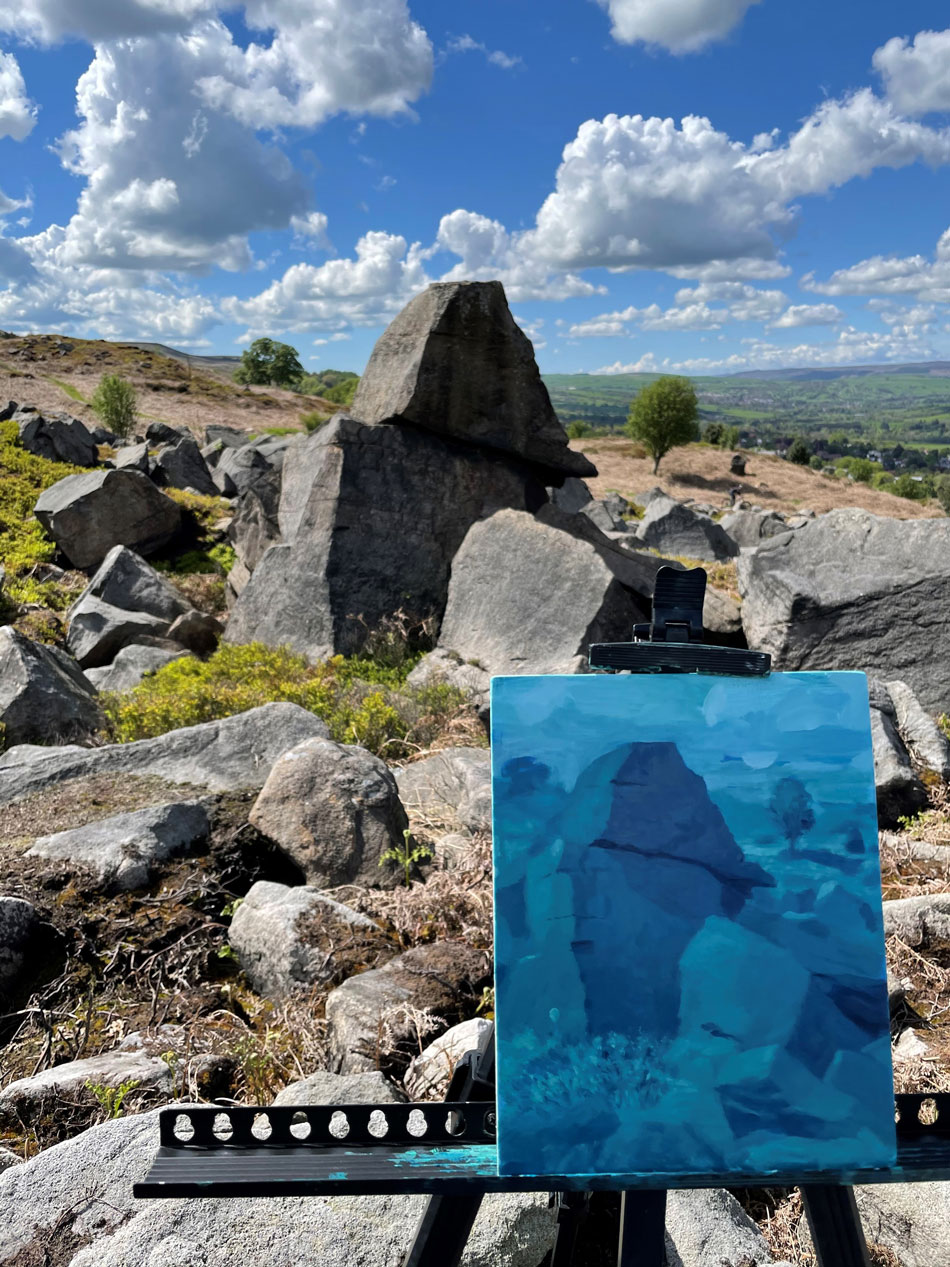
Above Ilkley, near my studio, is a large glacial boulder field marking the end of the moorland plateau. Boulders of different sizes rest alone, like monoliths or in clusters, sometimes piled improbably upon each other. The hard gritstone has few natural faultlines, but where broken or cracked, the parting often follows a straight edge. Although I’ve known this landscape all of my life, it took the restrictions of lockdown to cause me to revisit it with fresh eyes.
I realised after a while that I was making these paintings in a vertical, or portrait, format – a preference I’ve applied almost exclusively lately – and that this led to a thought that, perhaps, these are portraits. They are certainly cropped closely and any contextual expanse is minimal. For recognition purposes I had already started naming these rocks by their apparent (to me at least) characteristics: Split Rock, The Axe, Locomotive Rock (in memory of my Dad), Wizard’s Hat Rock etc. etc. Naming these gritstone blocks reminded me of my (very moderate) rock climbing days, where cliff features were named by their conquering rock climber heros. In nearby Ilkley Quarry is an arete route up an unforgiving gritstone block named ‘The New Statesman’ graded E9 (E nine) and first climbed by Jon Dunne in 1987., who’s shop on Manningham Lane I used to buy climbing gear from. It is still one of the hardest rock climbs put up on gritstone in the world.
Common ground
 relphster.info